Khóa học
IELTS Online
IELTS Online
Giảm đến 18%
Đăng ký ngay
Mục lục [Ẩn]
Đề thi IELTS Reading ngày 23.01.2026 gồm ba passage: Sorry – Who are you?, Should we try to bring extinct species back to life?, Yawning. Bài viết dưới đây cung cấp lời giải chi tiết từng câu hỏi và nội dung cụ thể của từng bài đọc trong đề thi thật, giúp bạn nắm rõ cấu trúc đề và chủ động hơn khi luyện tập với đề thi thật.
Sorry - Who Are You?
Prosopagnosia is a medical condition that stops people from recognizing faces. But how common is it and why does it happen?
It was Jacob Hodes' first day at college. He can still recall spending an enjoyable afternoon being shown around campus by a second-year student named Daniel Byrne, who happened to be from his hometown. Jacob then spent the rest of the year ignoring him. "I never saw him again," he says. "Well, I'm sure I walked past him plenty of times, but I just didn't see him." This behavior wasn't intentional. Jacob just couldn't recollect what his fellow student looked like. He had had the same trouble all his life. Friends and relatives would greet him, and he would have no idea who they were.
It wasn't until five years ago that it all made sense. That was when Hodes was diagnosed with prosopagnosia, a condition that means he is unable to recognize faces. According to researchers, he is far from alone. In fact, the condition is not that uncommon, but until a few years ago, only a few dozen cases had ever been described, and all of these had been caused by brain injury. Recently, though, researchers identified a second form of face blindness - developmental prosopagnosia, which is either present from birth or develops very early in life.
In May, a team from Harvard University in the US and University College London (UCL) announced the results of a web survey of 1,600 people, suggesting that up to 2 percent of people have some degree of face blindness. Then in August, Martina Gruter and colleagues at the Institute for Human Genetics in Münster, Germany, similarly reported that 2.5 percent of 700 secondary school pupils they had tested had trouble recognizing faces. The results of the survey took everyone by surprise.
It seems that if you have never known what it is to recognize a face, you don't necessarily know that you are supposed to be able to. "Prosopagnosics almost always know that they have trouble recognizing people, but they often don't realize that other people have better recognition skills than they do," says Brad Duchaine, a researcher at UCL.
Despite these issues, the majority of developmental prosopagnosics possess strategies that allow them to get around their difficulty. For instance, they recognize hair, clothing, or a person's way of speaking. So, unless they see a familiar person out of context, with a new hairstyle or in different clothes, they can recognize people just fine. Even so, the discovery of developmental prosopagnosia has attracted attention from neuroscientists keen to discover what is different about the brain of face-blind people. This difference, they believe, could help solve the problem of how the brain deals with information in general - not just visual data. In other words, it may show whether the brain has specialized parts for specific tasks or is more of a general-purpose information processor.
One issue, however, that will present challenges for researchers is that no two prosopagnosics are the same. Some have problems only with faces, while others have trouble with ordinary everyday objects and, so it turns out, animals, which would normally be familiar as well. Some prosopagnosics can train themselves to recognize specific faces; others can't even recognize their own in a mirror. When some have been tested, they could identify the emotion conveyed on another's face, even though the face itself seemed unfamiliar, while for other subjects, this was an impossibility. Some cannot recognize the faces of old friends or fellow students but have no trouble telling whether a particular face from such groups would be attractive to most people. Because of this diversity, working out the cause of prosopagnosia will not be easy.
In Martina Gruter's study, the prosopagnosics who agreed to have their parents and relatives tested reported at least one with the condition. Having looked at 38 cases in seven families, the German team believes they have good evidence that a single gene could be responsible. Duchaine also has some evidence that face blindness could be inherited but thinks other factors might be more significant. He refers to studies of babies born with a condition that means the eye's lens is not clear, and when it's the left one, being unable to see through this eye during the first two months of life is a major risk factor for prosopagnosia.
Whatever the cause, what most prosopagnosics want to know is whether they can do anything to improve their face recognition skills. Joseph Degutis, a graduate student at the University of California, recently reported successfully training a severe developmental prosopagnosic to recognize faces during tests carried out in the laboratory. The subject also reported that recognizing faces in everyday life became easier due to the training. Duchaine now plans to attempt to train sufferers to recognize the five people that they most need to know - maybe their immediate family, for example, and essential colleagues.
However, Martina Gruter's husband, who also works on her team, is not convinced it will work. "I don't know how you can have more training than you have already had," he says. "Humans already spend all day looking at faces." He also points out that cheating is a possibility during tests and provides an example: one person they studied said that when she was doing the face-recognition test, she memorized the distance between the nose and upper lip. She wasn't the only one. "So, you can perform well in the test and not do so well in real life."

Questions 1-7
Do the following statements agree with the information given in Reading Passage 1?
In boxes 1-7 on your answer sheet, write:
TRUE – if the statement agrees with the information
FALSE – if the statement contradicts the information
NOT GIVEN – if there is no information on this
Before attending college, Jacob was capable of recognizing people he knew well.
Researchers believe that prosopagnosia may be a growing problem.
It is harder to identify developmental prosopagnosia in babies than in young children.
A German study seems to support the Harvard and UCL research findings.
In general, prosopagnosics are aware that other people can recognize faces more easily than they can.
In most cases, prosopagnosics have developed ways to deal with their problem.
The study of prosopagnosia may help neuroscientists to treat different kinds of brain injury.
Questions 8-13
Complete the notes below.
Choose ONE WORD ONLY from the passage for each answer.
Write your answer in boxes 8-13 on your answer sheet.
Differences in prosopagnosis
The challenges for prosopagnosia researchers
As well as being unable to recognize facial features, prosopagnosics may also have problems recognizing commonly seen 8……………………………….
The 9 …………………………………….and objects on someone else's face.
Some prosopagnosics can recognize that people are regarded as attractive by others.
Causes of prosopagnosia
Prosopagnosia may be caused by
just one 10 ……………………………………….. according to Martina Gruter
a defect in the 11 ………………………………….. eye according to Brad Duchane
Treatment for prosopagnosia
Joseph Degutis patent proved he had been successfully trained to recognize faces inside the 12 …………………………………… and in the outside world.
Duchaine’s training may allow prosopagnosics to recognise faces belonging to family and workmates.
Thomas Gruter doubts that train will work and mentions that 13 …………………………………… by some subjects can affect research results.
>>> XEM THÊM:
Đề thi IELTS Reading có đáp án mới nhất 2025-2026 [Cập nhật liên tục]
Giải đề thi thật IELTS Reading ngày 04.01.2026 [Full Answers]
Bảng đáp án đề IELTS READING ngày 23.01.2026 PASSAGE 1
|
1. False |
8. Animals |
|
2. True |
9. Emotion |
|
3. Not given |
10. Gene |
|
4. True |
11. Left |
|
5. False |
12. Laboratory |
|
6. True |
13. Cheating |
|
7. Not given |
XEM ĐÁP ÁN CHI TIẾT TẠI ĐÂY: Giải đề IELTS Reading: Sorry - Who Are You? [Full answers]
Should we try to bring extinct species back to life?
A. The passenger pigeon was a legendary species. Flying in vast numbers across North America, with potentially many millions within a single flock, their migration was once one of nature’s great spectacles. Sadly, the passenger pigeon’s existence came to an end on 1 September 1914, when the last living specimen died at Cincinnati Zoo. Geneticist Ben Novak is lead researcher on an ambitious project which now aims to bring the bird back to life through a process known as ‘de-extinction’. The basic premise involves using cloning technology to turn the DNA of extinct animals into a fertilised embryo, which is carried by the nearest relative still in existence – in this case, the abundant band-tailed pigeon – before being born as a living, breathing animal. Passenger pigeons are one of the pioneering species in this field, but they are far from the only ones on which this cutting-edge technology is being trialled.
B. In Australia, the thylacine, more commonly known as the Tasmanian tiger, is another extinct creature which genetic scientists are striving to bring back to life. ‘There is no carnivore now in Tasmania that fills the niche which thylacines once occupied,’ explains Michael Archer of the University of New South Wales. He points out that in the decades since the thylacine went extinct, there has been a spread in a ‘dangerously debilitating’ facial tumour syndrome which threatens the existence of the Tasmanian devils, the island’s other notorious resident. Thylacines would have prevented this spread because they would have killed significant numbers of Tasmanian devils. ‘If that contagious cancer had popped up previously, it would have burned out in whatever region it started. The return of thylacines to Tasmania could help to ensure that devils are never again subjected to risks of this kind.’
C. If extinct species can be brought back to life, can humanity begin to correct the damage it has caused to the natural world over the past few millennia? ‘The idea of de-extinction is that we can reverse this process, bringing species that no longer exist back to life,’ says Beth Shapiro of University of California Santa Cruz’s Genomics Institute. ‘I don’t think that we can do this. There is no way to bring back something that is 100 per cent identical to a species that went extinct a long time ago.’ A more practical approach for long-extinct species is to take the DNA of existing species as a template, ready for the insertion of strands of extinct animal DNA to create something new; a hybrid, based on the living species, but which looks and/or acts like the animal which died out.
D. This complicated process and questionable outcome begs the question: what is the actual point of this technology? ‘For us, the goal has always been replacing the extinct species with a suitable replacement,’ explains Novak. ‘When it comes to breeding, band-tailed pigeons scatter and make maybe one or two nests per hectare, whereas passenger pigeons were very social and would make 10,000 or more nests in one hectare.’ Since the disappearance of this key species, ecosystems in the eastern US have suffered, as the lack of disturbance caused by thousands of passenger pigeons wrecking trees and branches means there has been minimal need for regrowth. This has left forests stagnant and therefore unwelcoming to the plants and animals which evolved to help regenerate the forest after a disturbance. According to Novak, a hybridized band-tailed pigeon, with the added nesting habits of a passenger pigeon, could, in theory, re-establish that forest disturbance, thereby creating a habitat necessary for a great many other native species to thrive.
E. Another popular candidate for this technology is the woolly mammoth. George Church, professor at Harvard Medical School and leader of the Woolly Mammoth Revival Project, has been focusing on cold resistance, the main way in which the extinct woolly mammoth and its nearest living relative, the Asian elephant, differ. By pinpointing which genetic traits made it possible for mammoths to survive the icy climate of the tundra, the project’s goal is to return mammoths, or a mammoth-like species, to the area. ‘My highest priority would be preserving the endangered Asian elephant,’ says Church, ‘expanding their range to the huge ecosystem of the tundra. Necessary adaptations would include smaller ears, thicker hair, and extra insulating fat, all for the purpose of reducing heat loss in the tundra, and all traits found in the now extinct woolly mammoth.’ This repopulation of the tundra and boreal forests of Eurasia and North America with large mammals could also be a useful factor in reducing carbon emissions – elephants punch holes through snow and knock down trees, which encourages grass growth. This grass growth would reduce temperature, and mitigate emissions from melting permafrost.
F. While the prospect of bringing extinct animals back to life might capture imaginations, it is, of course, far easier to try to save an existing species which is merely threatened with extinction. ‘Many of the technologies that people have in mind when they think about de-extinction can be used as a form of “genetic rescue”,’ explains Shapiro. She prefers to focus the debate on how this emerging technology could be used to fully understand why various species went extinct in the first place, and therefore how we could use it to make genetic modifications which could prevent mass extinctions in the future. ‘I would also say there’s an incredible moral hazard to not do anything at all,’ she continues. ‘We know that what we are doing today is not enough, and we have to be willing to take some calculated and measured risks.’

Questions 14 – 17
Reading Passage 2 has six paragraphs, A-F.
Which paragraph contains the following information?
Write the correct letter, A-F, in boxes 14-17 on your answer sheet.
NB You may use any letter more than once.
14. a reference to how further disappearance of multiple species could be avoided.
15. explanation of a way of reproducing an extinct animal using the DNA of only that species
16. reference to a habitat which has suffered following the extinction of a species
17. mention of the exact point at which a particular species became extinct
Questions 18 – 22
Complete the summary below. Choose NO MORE THAN TWO WORDS from the passage for each answer. Write your answers in boxes 18-22 on your answer sheet.
The woolly mammoth revival project
Professor George Church and his team are trying to identify the 18.__________ which enabled mammoths to live in the tundra. The findings could help preserve the mammoth’s close relative, the endangered Asian elephant.
According to Church, introducing Asian elephants to the tundra would involve certain physical adaptations to minimise 19.__________ To survive in the tundra, the species would need to have the mammoth-like features of thicker hair, 20.__________ of a reduced size and more 21.__________
Repopulating the tundra with mammoths or Asian elephant/mammoth hybrids would also have an impact on the environment, which could help to reduce temperatures and decrease 22.__________
Questions 23 – 26
Look at the following statements (Questions 23-26) and the list of people below. Match each statement with the correct person, A, B or C. Write the correct letter, A, B or C, in boxes 23-26 on your answer sheet.
NB You may use any letter more than once.
23. Reintroducing an extinct species to its original habitat could improve the health of a particular species living there.
24. It is important to concentrate on the causes of an animal’s extinction.
25. A species brought back from extinction could have an important beneficial impact on the vegetation of its habitat.
26. Our current efforts at preserving biodiversity are insufficient.
List of People
A. Ben Novak
B. Michael Archer
C. Beth Shapiro
>>> XEM THÊM:
Cách làm Multiple Choice trong IELTS Reading ẵm trọn điểm tối đa
Cách làm Matching Information trong IELTS Reading “ẵm trọn” điểm cao
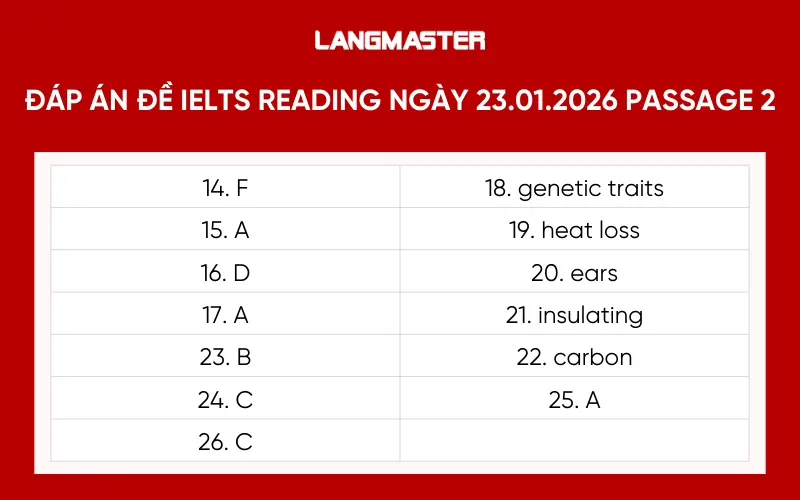
Bảng đáp án đề IELTS READING ngày 23.01.2026 PASSAGE 2
|
14. F |
18. genetic traits |
|
15. A |
19. heat loss |
|
16. D |
20. ears |
|
17. A |
21. insulating |
|
23. B |
22. carbon |
|
24. C |
25. A |
|
26. C |
Questions 14 – 17: Matching Information
14. F
Phân tích: Đoạn F đề cập đến công nghệ “genetic rescue” và khả năng sử dụng chỉnh sửa di truyền để ngăn chặn các đợt tuyệt chủng hàng loạt trong tương lai.
Từ khóa quan trọng: “genetic modifications”, “prevent mass extinctions”.
15. A
Phân tích: Đoạn A giải thích nguyên lý cơ bản của công nghệ hồi sinh loài tuyệt chủng (de-extinction), cụ thể là sử dụng công nghệ nhân bản để tạo phôi từ DNA của loài đã mất.
Từ khóa chính: “cloning technology”, “fertilised embryo”.
16. D
Phân tích: Đoạn D nói về sự suy giảm và trì trệ của hệ sinh thái miền đông nước Mỹ sau khi loài bồ câu viễn khách biến mất.
Từ khóa: “ecosystems… have suffered”, “forests stagnant”.
17. A
Phân tích: Đoạn A nêu rõ mốc thời gian tuyệt chủng của bồ câu viễn khách: ngày 1/9/1914 tại vườn thú Cincinnati.
Từ khóa: “1 September 1914”, “Cincinnati Zoo”.
Questions 18 – 22: Summary Completion
18. genetic traits
Phân tích: Giáo sư George Church nghiên cứu các đặc điểm di truyền giúp voi ma mút thích nghi với khí hậu lạnh giá.
Từ khóa: “genetic traits”, “survive the icy climate”.
19. heat loss
Phân tích: Mục tiêu của việc chỉnh sửa gen là giảm thiểu sự mất nhiệt khi sinh sống ở vùng lãnh nguyên.
Từ khóa: “reducing heat loss”.
20. ears
Phân tích: Tai nhỏ hơn là một trong những đặc điểm giúp hạn chế thất thoát nhiệt.
Từ khóa: “smaller ears”.
21. insulating
Phân tích: Loài lai cần có lớp mỡ cách nhiệt dày hơn để thích nghi với môi trường lạnh.
Từ khóa: “insulating fat”.
22. carbon
Phân tích: Việc đưa các loài lớn trở lại lãnh nguyên có thể giúp giảm lượng khí thải carbon từ băng vĩnh cửu tan chảy.
Từ khóa: “mitigate emissions”.
Questions 23 – 26: Matching Feature
23. B
Giải thích: Michael Archer cho rằng việc tái đưa hổ Tasmania (thylacine) trở lại tự nhiên có thể giúp kiểm soát bệnh u mặt đang đe dọa quỷ Tasmania, từ đó bảo vệ quần thể loài này khỏi nguy cơ suy giảm nghiêm trọng.
Vị trí: Đoạn B: “The return of thylacines to Tasmania could help to ensure that devils are never again subjected to risks of this kind.”
24. C
Giải thích: Beth Shapiro nhấn mạnh rằng điều quan trọng không chỉ là hồi sinh loài tuyệt chủng, mà còn phải tìm hiểu nguyên nhân sâu xa khiến chúng biến mất ngay từ đầu.
Vị trí: Đoạn F: “She prefers to focus the debate on how this emerging technology could be used to fully understand why various species went extinct in the first place…”
25. A
Giải thích: Ben Novak tin rằng việc phục hồi bồ câu viễn khách (phiên bản lai) có thể tái tạo lại sự xáo trộn tự nhiên của rừng, từ đó tạo điều kiện cho nhiều loài thực vật và động vật bản địa phát triển.
Vị trí: Đoạn D: “…could, in theory, re-establish that forest disturbance, thereby creating a habitat necessary for a great many other native species to thrive.”
26. C
Giải thích: Beth Shapiro cho rằng các biện pháp bảo tồn hiện nay vẫn chưa đủ mạnh để bảo vệ đa dạng sinh học, vì vậy cần có những giải pháp công nghệ mới hiệu quả hơn.
Vị trí: Đoạn F: “We know that what we are doing today is not enough…”
>>> XEM THÊM:
Yawning
How and why we yarn still presents problems for researchers in an area which has only recently been opened up to study
When Robert R Provine began studying yawning in the 1960s, it was difficult for him to convince research students of the merits of ‘yawning science1. Although it may appear quirky to some, Provine’s decision to study yawning was a logical extension of his research in developmental neuroscience.
The verb ‘to yawn’ is derived from the Old English ganien or ginian, meaning to gape or open wide. But in addition to gaping jaws, yawning has significant features that are easy to observe and analyse. Provine ‘collected’ yawns to study by using a variation of the contagion response*. He asked people to ‘think about yawning’ and, once they began to yawn to depress a button and that would record from the start of the yawn to the exhalation at its end.
Provine’s early discoveries can be summanized as follows: the yawn is highly stereotyped but not invariant in its duration and form. It is an excellent example of the instinctive ‘fixed action pattern’ of classical animal-behavior study, or ethology. It is not a reflex (short-duration, rapid, proportional response to a simple stimulus), but, once started, a yawn progresses with the inevitability of a sneeze. The standard yawn runs its course over about six seconds on average, but its duration can range from about three seconds to much longer than the average. There are no half-yawns: this is an example of the typical intensity of fixed action patterns and a reason why you cannot stifle yawns. Just like a cough, yawns can come in bouts with a highly variable inter-yawn interval, which is generally about 68 seconds but rarely more than 70. There is no relation between yawn frequency and duration: producers of short or long yawns do not compensate by yawning more or less often. Furthermore, Provine’s hypotheses about the form and function of yawning can be tested by three informative yawn variants which can be used to look at the roles of the nose, the mouth and the jaws.
i) The closed nose yawn
Subjects are asked to pinch their nose closed when they feel themselves start to yawn. Most subjects report being able to perform perfectly normal closed nose yawns. This indicates that the inhalation at the onset of a yawn, and the exhalation at its end, need not involve the nostrils – the mouth provides a sufficient airway.
ii) The clenched teeth yawn
Subjects are asked to clench their teeth when they feel themselves start to yawn but allow themselves to inhale normally through their open lips and clenched teeth. This variant gives one the sensation of being stuck midyawn. This shows that gaping of the jaws is an essential component of the fixed action pattern of the yawn, and unless it is accomplished, the program (or pattern) will not run to completion. The yawn is also shown to be more than a deep breath, because, unlike normal breathing, inhalation and exhalation cannot be performed so well through the clenched teeth as through the nose.
iii) The nose yawn
This variant tests the adequacy of the nasal airway to sustain a yawn. Unlike normal breathing, which can be performed equally well through mouth or nose, yawning is impossible via nasal inhalation alone. As with the clenched teeth yawn, the nose yawn provides the unfulfilling sensation of being stuck in mid-yawn. Exhalation, on the other hand, can be accomplished equally well through nose or mouth. Through thin methodology Provine demonstrated that inhalation through the oral airway and the gaping of jaws are necessary for normal yawns. The motor program for yawning will not run to completion without feedback that these parts of the program have been accomplished.
But yawning is a powerful, generalized movement that involves much more than airway maneuvres and jaw-gaping. When yawning you also stretch your facial muscles, tilt your head back, narrow or close your eyes, produce tears, salivate, open the Eustachian tubes of your middle ear and perform many other, yet unspecified, cardiovascular and respiratory acts. Perhaps the yawn shares components with other behaviour. For example, in the yawn a kind of ‘slow sneeze1 or is the sneeze a ‘fast yawn’? Both share common respiratory and other features including jaw gaping, eye closing and head tilting.
Yawning and stretching share properties and may be performed together as parts of a global motor complex. Studies by J I p deVries et al. in the early 1980s, charting movement in the developing foet US using ultrasound, observed a link between yawning and stretching. The most extraordinary demonstration of the yawn-stretch linkage occurs in many people paralyzed on one side of their body because of brain damage caused by a stroke, the prominent British neurologist Sir Francis Walshe noted in 1923 that when these people yawn, they are startled and mystified to observe that their otherwise paralyzed arm rises and flexes automatically in what neurologists term an ‘associated response’. Yawning apparently activates undamaged, unconsciously controlled connections between the brain and the motor system, causing the paralyzed limb to move. It is not known whether the associated response is a positive prognosis for recovery, nor whether yawning is therapeutic for prevention of muscular deterioration.
Provine speculated that, in general, yawning may have many functions, and selecting a single function from the available options may be an unrealistic goal. Yawning appears to be associated with a change of behavioral state, switching from one activity to another. Yawning is also a reminder that ancient and unconscious behavior linking US to the animal world lurks beneath the veneer of culture, rationality and language.

Questions 27 – 32
Complete the summary below using the list of words, A-K, below
Write the correct letter, A-K, in boxes 15-20 on your answer sheet.
Provine’s early findings on yawns
Through his observation of yawns, Province was able to confirm that 27.______ do not exist.
Just like a 28._______, yawns cannot be interrupted after they have begun. This is because yawns occur as a 29.______ rather than a stimulus response as was previously thought.
In measuring the time taken to yawn, provive found that a typical yawn lasts about 30.______. He also found that it is a common for people to yawn a number of times in quick succession with the yawns usually being around 31._____ apart. When studying whether length and rate were connected. Province concluded that people who yawn less do not necessarily produce 32._____ to make up for this.
A. form and function
B. long yawns
C. 3 seconds
D. fixed action pattern
E. 68 seconds
F. short yawns
G. reflex
H. sneeze
I. short duration
J. 6 seconds
K. half-yawns
Questions 33 – 37
Choose the correct letter, A, B, C or D.
Write the correct letter in boxes 33 – 37 on your answer sheet.
33. What did Provine conclude from his ‘closed nose yawn1 experiment?
A Ending a yawn requires use of the nostrils.
B You can yawn without breathing through your nose
C Breathing through the nose produces a silent yawn.
D The role of the nose in yawning needs further investigation.
34. Provine’s clenched teeth yawn’s experiment shows that
A yawning is unconnected with fatigue.
B a yawn is the equivalent of a deep intake of breath.
C you have to be able to open your mouth wide to yawn.
D breathing with the teeth together is as efficient as through the nose.
35. The nose yawn experiment was used to test weather yawning
A can be stopped after it has stated
B is the result of motor programing
C involves both inhalation and exhalation.
D can be accomplished only through the nose.
36. In people paralyzed on one side because of brain damage
A yawning may involve only one side of the face.
B the yawing response indicates that recovery is likely
C movement in paralysed arm is stimulated by yawming
D yawning can be used as an example to prevent muscle wasting.
37. In the last paragraph, the writer concludes that
A yawning is a sign of boredom.
B we yawn is spite of the development of our species
C yawning is a more passive activity than we Imagine
D we are stimulated to yawn when our brain activity is low.
Questions 38 – 40
Do the following statements agree with the claims of the writer in Reading Passage?
In boxes 37-40 on your answer sheet, write
YES if the statement agrees with the views of the writer
NO if the statement contradicts the views of the writer
NOT GIVEN if it is impossible to say what the writer thinks about this
38. Research students were initially reluctant to appreciate the value of Provine’s studies.
39. When foetuses yawn and stretch they are learning how to control movement.
40. According to Provine, referring to only one function is probably inadequate to explain why people yawn.
>>> XEM THÊM:
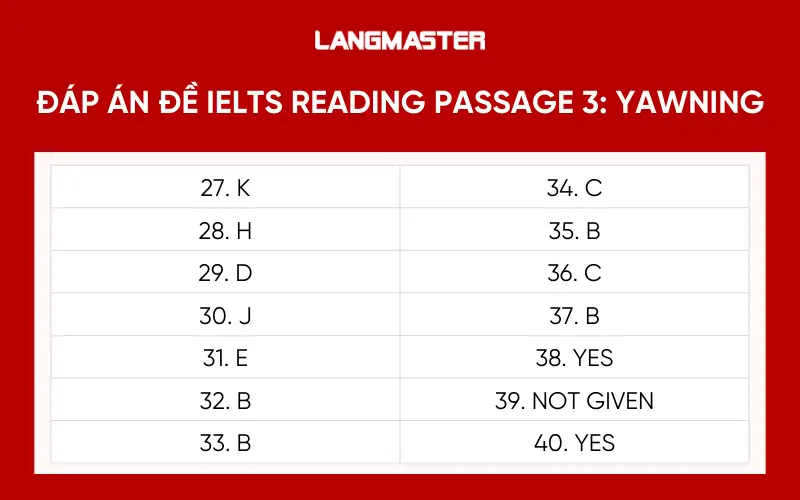
Bảng đáp án đề IELTS READING ngày 23.01.2026 PASSAGE 3
|
27. K |
34. C |
|
28. H |
35. B |
|
29. D |
36. C |
|
30. J |
37. B |
|
31. E |
38. YES |
|
32. B |
39. NOT GIVEN |
|
33. B |
40. YES |
Đáp án chi tiết 27 - 32
Câu 27. K – half-yawns
Summary: “Through his observation of yawns, Provine was able to confirm that ______ do not exist.”
Trong bài có câu: “There are no half-yawns.”
→ Không tồn tại “ngáp nửa chừng”.
→ Đáp án: half-yawns.
Câu 28. H – sneeze
Summary: “Just like a ______, yawns cannot be interrupted after they have begun.”
Trong bài: “once started, a yawn progresses with the inevitability of a sneeze.”
Ngáp giống như hắt hơi – đã bắt đầu thì không dừng lại được.
→ Đáp án: sneeze.
Câu 29. D – fixed action pattern
Summary: “yawns occur as a ______ rather than a stimulus response…”
Trong bài: “It is an excellent example of the instinctive ‘fixed action pattern’… It is not a reflex.”
→ Ngáp không phải reflex (phản xạ) → Mà là fixed action pattern (một chương trình vận động cố định).
→ Đáp án: fixed action pattern.
Câu 30. J – 6 seconds
Summary: “a typical yawn lasts about ______.”
Trong bài: “The standard yawn runs its course over about six seconds on average.”
→ Đáp án: 6 seconds.
Câu 31. E – 68 seconds
Summary:
“yawns usually being around ______ apart.”
Trong bài: “inter-yawn interval… generally about 68 seconds.” Khoảng cách giữa hai lần ngáp ≈ 68 giây.
→ Đáp án: 68 seconds.
32. B (long yawns)
Phân tích: Provine kết luận rằng không có mối liên hệ giữa tần suất và thời lượng ngáp; người ngáp ít không nhất thiết phải ngáp dài để bù đắp.
Trong bài - Đoạn 3: “There is no relation between yawn frequency and duration: producers of short or long yawns do not compensate by yawning more or less often.”.
Đáp án chi tiết 33 - 37
Câu 33. B
“Most subjects report being able to perform perfectly normal closed nose yawns.”
Dịch: Hầu hết người tham gia vẫn có thể ngáp hoàn toàn bình thường dù bị bịt mũi.
→ Suy ra: Ngáp không bắt buộc phải thở qua mũi.
→ Đáp án đúng: B (You can yawn without breathing through your nose.)
Câu 34. C
Trong bài viết: “This shows that gaping of the jaws is an essential component of the fixed action pattern of the yawn, and unless it is accomplished, the program will not run to completion.”
Dịch: Điều này cho thấy việc há rộng hàm là thành phần thiết yếu của hành động ngáp, và nếu không thực hiện được thì cái ngáp sẽ không hoàn thành.
→ Suy ra: Phải mở miệng rộng mới ngáp hoàn chỉnh. → Đáp án đúng: C.
Câu 35. B
Trong bài viết:“The motor program for yawning will not run to completion without feedback that these parts of the program have been accomplished.”
Dịch: Chương trình vận động của hành động ngáp sẽ không hoàn thành nếu các bước cần thiết chưa được thực hiện.
→ Suy ra: Ngáp là một “motor program” (chương trình vận động có trình tự). → Đáp án đúng: B.
Câu 36. C
Trong bài viết: “their otherwise paralyzed arm rises and flexes automatically…”
Dịch: Cánh tay vốn bị liệt của họ tự động nâng lên và co lại khi ngáp.
→ Suy ra: Ngáp kích thích cánh tay bị liệt cử động. → Đáp án đúng: C.
Câu 37. B
Trong bài viết: “Yawning is also a reminder that ancient and unconscious behavior linking us to the animal world lurks beneath the veneer of culture…”
Dịch: Ngáp nhắc nhở rằng đây là hành vi cổ xưa và vô thức, liên kết con người với thế giới động vật.
→ Suy ra: Dù con người đã phát triển văn minh, hành vi này vẫn tồn tại. → Đáp án đúng: B.
Đáp án chi tiết 38-40
Câu 38. YES
Trong bài viết: “it was difficult for him to convince research students of the merits of ‘yawning science’.”
Dịch: Ông gặp khó khăn khi thuyết phục sinh viên nghiên cứu rằng lĩnh vực này có giá trị.
→ Đồng ý với nhận định. → YES.
Câu 39. NOT GIVEN
Trong bài viết chỉ nói: “observed a link between yawning and stretching.”
Dịch: Quan sát thấy có mối liên hệ giữa ngáp và vươn người ở thai nhi.
→ Không có thông tin nói thai nhi đang “học cách điều khiển cơ thể”. → NOT GIVEN.
Câu 40. YES
Trong bài viết: “selecting a single function from the available options may be an unrealistic goal.”
Dịch: Việc chọn một chức năng duy nhất để giải thích ngáp có thể là mục tiêu không thực tế.
→ Tác giả đồng ý rằng không thể giải thích ngáp chỉ bằng một lý do. → YES.
>>> XEM THÊM:
Khi luyện đề IELTS Reading ngày 23.01.2026 nhiều học viên thường gặp khó khăn trong việc xác định dạng câu hỏi và áp dụng từ vựng học thuật một cách chính xác. Để đạt hiệu quả cao, cần có một kế hoạch ôn tập logic, kết hợp với chiến lược làm bài rõ ràng và sự hỗ trợ từ giáo viên nhiều kinh nghiệm.
Để đáp ứng nhu cầu, Langmaster xây dựng các khóa học IELTS online với lộ trình cá nhân hóa. Học viên sẽ được giảng viên theo sát, chỉ ra lỗi sai ngay lập tức trong vòng 24 giờ và hướng dẫn phương pháp học tập tối ưu để tiến bộ nhanh chóng hơn.

Tại Langmaster học viên được:
Coaching 1 - 1 với chuyên gia: Học viên được kèm riêng để khắc phục điểm yếu, phân bổ thời gian thi chi tiết, tập trung rèn kỹ năng chưa vững và rút ngắn lộ trình nâng band.
Sĩ số lớp nhỏ, 7 - 10 học viên: Giáo viên theo sát từng bạn, nhiều cơ hội trao đổi và nhận phản hồi chi tiết.
Lộ trình học cá nhân hóa: Thiết kế dựa trên trình độ đầu vào và mục tiêu điểm số, kèm báo cáo tiến bộ hàng tháng.
Giáo viên 7.5+ IELTS: Chấm chữa bài trong 24 giờ, giúp bạn cải thiện nhanh chóng và rõ rệt.
Thi thử định kỳ: Mô phỏng áp lực thi thật, phân tích điểm mạnh - yếu để điều chỉnh chiến lược học.
Cam kết đầu ra, học lại miễn phí: Đảm bảo kết quả, giảm thiểu rủi ro “học xong vẫn chưa đạt mục tiêu”.
Học online tiện lợi, chất lượng như offline: Có bản ghi để xem lại, linh hoạt, tiết kiệm thời gian, chi phí.
Hệ sinh thái học tập toàn diện: Tài liệu chuẩn, bài tập online, cộng đồng học viên và cố vấn luôn đồng hành.
Đăng ký học thử IELTS Online miễn phí ngay hôm nay để trải nghiệm lớp học thực tế, kiểm tra trình độ và nhận lộ trình học tập hiệu quả, giúp bạn thành thạo kỹ năng IELTS Reading và chinh phục mục tiêu IELTS!
Khi ôn luyện đề IELTS Reading 23.01.2026 học viên không chỉ nắm vững đáp án đúng mà còn phát triển khả năng phân tích theo từng dạng câu hỏi một cách logic. Việc kết hợp từ vựng học thuật trong ngữ cảnh thực tế giúp ghi nhớ hiệu quả, đồng thời mở rộng vốn từ cần thiết cho kỹ năng đọc học thuật. Chúc bạn ôn luyện thật tốt và đạt kết quả cao trong kỳ thi sắp tới!




Các dạng bài phổ biến và tiêu chí chấm điểm IELTS Reading chi tiết nhất: Multiple Choice, Matching Information, Matching Headings,... và hướng dẫn chiến lược làm bài hiệu quả

Những sai lầm khi luyện IELTS Reading bao gồm: dịch từng từ, đọc hết cả bài, không đọc câu hỏi trước, không quản lý thời gian, không nắm vững kỹ năng paraphrase, viết sai chính tả
![Giải đề IELTS Reading: A brief history of humans and food [full answers]](https://langmaster.edu.vn/storage/images/2025/09/20/a-brief-history-of-humans-and-food-ielts-reading-answers.webp)
Giải đề thi IELTS Reading “A brief history of humans and food” kèm full đề thi thật, câu hỏi, đáp án, giải thích chi tiết, và từ vựng cần lưu ý khi làm bài.
Tổng hợp IELTS Reading tips hay nhất giúp bạn đọc nhanh, nắm ý chính và xử lý thông tin chính xác, tự tin đạt điểm cao trong kỳ thi IELTS.
![Giải đề IELTS Reading: The importance of law [Full answers]](https://langmaster.edu.vn/storage/images/2025/09/22/55.webp)
Giải đề IELTS Reading “The importance of law” kèm đáp án chi tiết, từ vựng quan trọng và bí quyết luyện thi hiệu quả để nâng cao band điểm.



Hơn 16 năm kinh nghiệm, đào tạo thành công 800.000+ học viên
Phương pháp giảng dạy hiện đại, học viên tiến bộ rõ rệt
Lộ trình học chuẩn quốc tế, phù hợp với nhu cầu thực tiễn
Giáo viên đạt chuẩn Quốc tế với chất lượng top đầu thị trường, giàu kinh nghiệm
Học online linh hoạt, cam kết đầu ra bằng văn bản

![Giải đề thi thật IELTS Reading ngày 04.01.2026 [Full Answers]](https://langmaster.edu.vn/storage/uploads/original/2026/02/22/ielts-reading-04-01-2026.png)

![Giải đề thi thật IELTS Reading ngày 16.01.2026 [Full Answers]](https://langmaster.edu.vn/storage/uploads/original/2026/02/24/ielts-reading-16-01-2026.png)
![Giải đề thi thật IELTS Reading ngày 13.01.2026 [Full Answers]](https://langmaster.edu.vn/storage/uploads/original/2026/02/25/ielts-reading-13-01-2025.png)